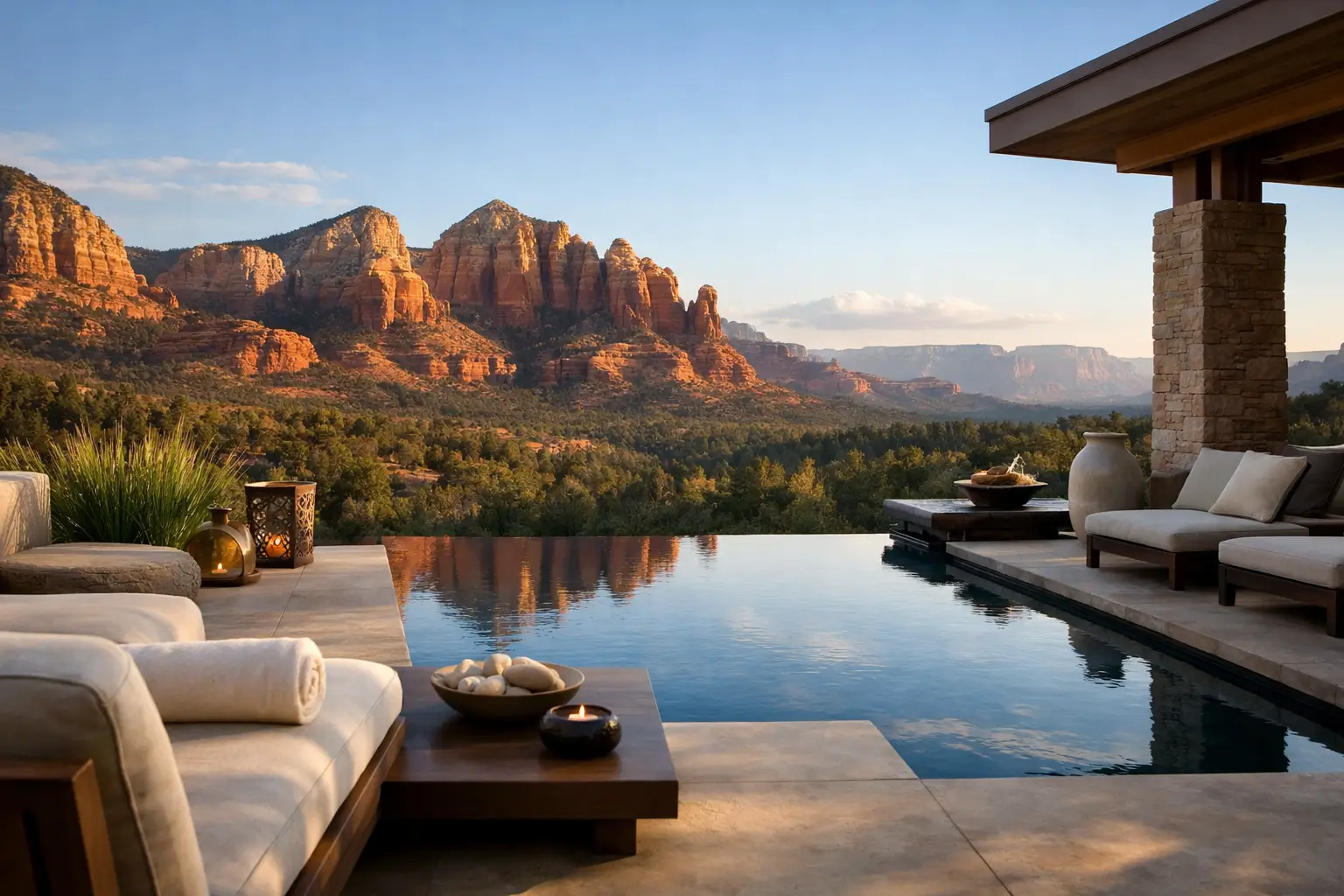

A quiet retreat is not simply a beautiful room with the volume turned down. It is a deliberate change in what your mind and body are asked to process. The science behind luxurious quiet retreat begins here: when visual clutter, unpredictable noise, crowded schedules, and constant decisions recede, the nervous system has room to soften.
For couples arriving in Sedona after demanding seasons of work, family life, or wedding planning, that softening can feel almost immediate. Red rock catches the late-day light. A private courtyard holds the warmth of the afternoon. There is nowhere to rush, no lobby to cross, no pressure to perform a version of relaxation. Quiet luxury creates conditions where restoration can become more than an idea.
Why Privacy Changes the Way We Rest
Privacy is often treated as a premium amenity, but it also has a physiological value. In public or busy environments, the brain remains alert to interruption. It tracks footsteps, conversations, other people’s movements, and the subtle social expectation to be available. Even when we are physically still, part of the mind may remain on watch.
A truly private setting reduces that background vigilance. Guests can move at their own pace, linger over coffee, sleep later, or sit in silence without navigating another person’s agenda. For romantic travelers, privacy also makes room for deeper connection. Conversation tends to become less rushed when there is no next reservation, no crowded elevator, and no need to compete with the energy of a large resort.
This does not mean every traveler needs total isolation. Some guests are nourished by shared activity and lively social spaces. But for those carrying decision fatigue or emotional overload, seclusion can offer something rare: the freedom to stop managing the experience and simply inhabit it.
The Science Behind Luxurious Quiet Retreat Experiences
The body responds to its surroundings through the senses. That is why luxury feels most restorative when it is not only seen, but felt in the details: soft linens that invite longer sleep, a calm palette that gives the eyes a place to rest, natural textures that feel grounding beneath the hand, and a room arranged without visual excess.
Sensory design is not about stripping away all stimulation. A sterile space can feel cold, while a highly decorated one can demand attention. The most restful environments tend to offer gentle, coherent sensory cues. Warm light in the evening supports the body’s natural shift toward rest. Fresh air and comfortable temperature help sleep. A view of open landscape can ease the feeling of being enclosed by obligations.
Sound matters just as much. The absence of harsh, unpredictable noise gives the brain fewer signals to assess. In its place, softer sounds – wind through juniper, birds at dawn, a distant wash of rain, the resonant tone of a singing bowl – can create an auditory environment that feels steady rather than demanding. Sound bowl healing is not a substitute for medical care, and experiences vary by person, yet many guests find the slow, sustained tones deeply settling when paired with intentional rest.
Sleep Is Part of the Experience, Not Downtime
Luxury travel can accidentally become exhausting when every hour is planned. A restorative retreat makes sleep part of the itinerary. Quality sleep supports mood, memory, physical recovery, and emotional regulation. It also changes the texture of a trip. A morning hike becomes more pleasurable after unhurried rest. A couples massage can feel more deeply received when the body is not running on caffeine and adrenaline.
Sleep is shaped by more than a comfortable bed. Evening light, room temperature, quiet, familiar rituals, and a sense of safety all play a role. For some guests, the ideal retreat schedule includes an early dinner and a long night of sleep. For others, it may mean stargazing from a private outdoor space before returning to a dark, cool casita. The point is not perfection. It is to let the body set a more natural rhythm.
Sedona’s Landscape Offers Attention a Softer Place to Land
Nature does not erase stress on command, but it can shift attention away from the narrow, effortful focus required by screens, traffic, and deadlines. Researchers often describe this as restorative attention: the mind is gently engaged by a landscape without being asked to solve or produce anything.
Sedona is especially suited to this kind of restoration. The contours of the red rocks change with the sun. Trails invite movement without requiring competition. The horizon stretches beyond the scale of a calendar. For many visitors, the landscape offers perspective that is both emotional and physical.
The area’s energy-vortex identity adds another layer of meaning for guests who are spiritually curious. Whether one understands a vortex as sacred geography, a personal ritual, or simply a compelling place to pause, the experience can encourage intention. The benefit may not come from proving a particular belief. It may come from allowing yourself to be present enough to notice what arises in stillness.
At Eagle Dancer, direct proximity to the red-rock landscape makes this relationship with place more immediate. A day can hold both gentle adventure and deep rest: a quiet hike in the morning, a nourishing spa treatment in the afternoon, then sunset settling over the rocks from the privacy of the estate.
Restoration Needs a Little Structure
It may seem counterintuitive, but the most peaceful retreats often benefit from a light framework. Without one, guests can bring the frantic pace of home with them, answering messages between treatments or turning a getaway into another project to optimize.
The answer is not a rigid wellness schedule. It is a few thoughtful anchors. Begin the day without reaching for a phone. Choose one experience that supports the body, such as yoga, massage, or time on the trail. Leave a generous pocket of unscheduled time. End the day with a small ritual that tells the mind it can release the day’s demands.
For a couple, this structure can be shared without being identical. One partner may want a long hike while the other prefers meditation or a healing session. Quiet luxury honors both needs. Connection is not created by doing every moment together. Often, it is strengthened when each person has enough space to return to the other feeling more like themselves.
Touch, Ritual, and Emotional Safety
Massage and other body-centered wellness experiences can be meaningful because stress is not held only in thought. It often appears as a clenched jaw, shallow breath, tight shoulders, or the inability to be still. A skilled massage can invite the body to release some of that guarding, while slow breathing and intentional touch can help bring awareness back to the present moment.
The setting matters. A treatment offered in a peaceful, guest-exclusive environment carries a different quality than one squeezed between appointments in a busy spa. When there is time afterward to rest, drink water, take a bath, or sit quietly in the sun, the experience has a chance to settle rather than becoming another item checked off the list.
Ritual works in a similar way. It gives meaning to a pause. That might be a private sound bowl session before an anniversary dinner, a morning meditation before an elopement, or a shared moment of gratitude at the end of a babymoon. These practices do not need to be elaborate to feel sacred. Their power is often in repetition, attention, and the permission to slow down together.
Quiet Is Not the Absence of Life
The most memorable retreats are not silent in a rigid sense. They are alive with the right things: the hush of desert evening, the laughter that comes after a long exhale, the sound of water poured into a glass, the gentle fatigue of a day spent outdoors. Quiet is the removal of what competes for your attention so that what matters can be felt more fully.
That is the distinction between merely escaping and truly restoring. A luxurious quiet retreat gives you more than a place to stay. It gives your senses, your relationship, and your inner life enough spaciousness to return to their own natural cadence.
When planning your time away, protect at least one portion of the day from plans, screens, and expectation. Let the red rocks hold the view, let the room hold the quiet, and let that open space become the part of the journey you carry home.